MailMaestro pricing
 TeamsMaestro pricing




Plaud vs Pocket: the verdict
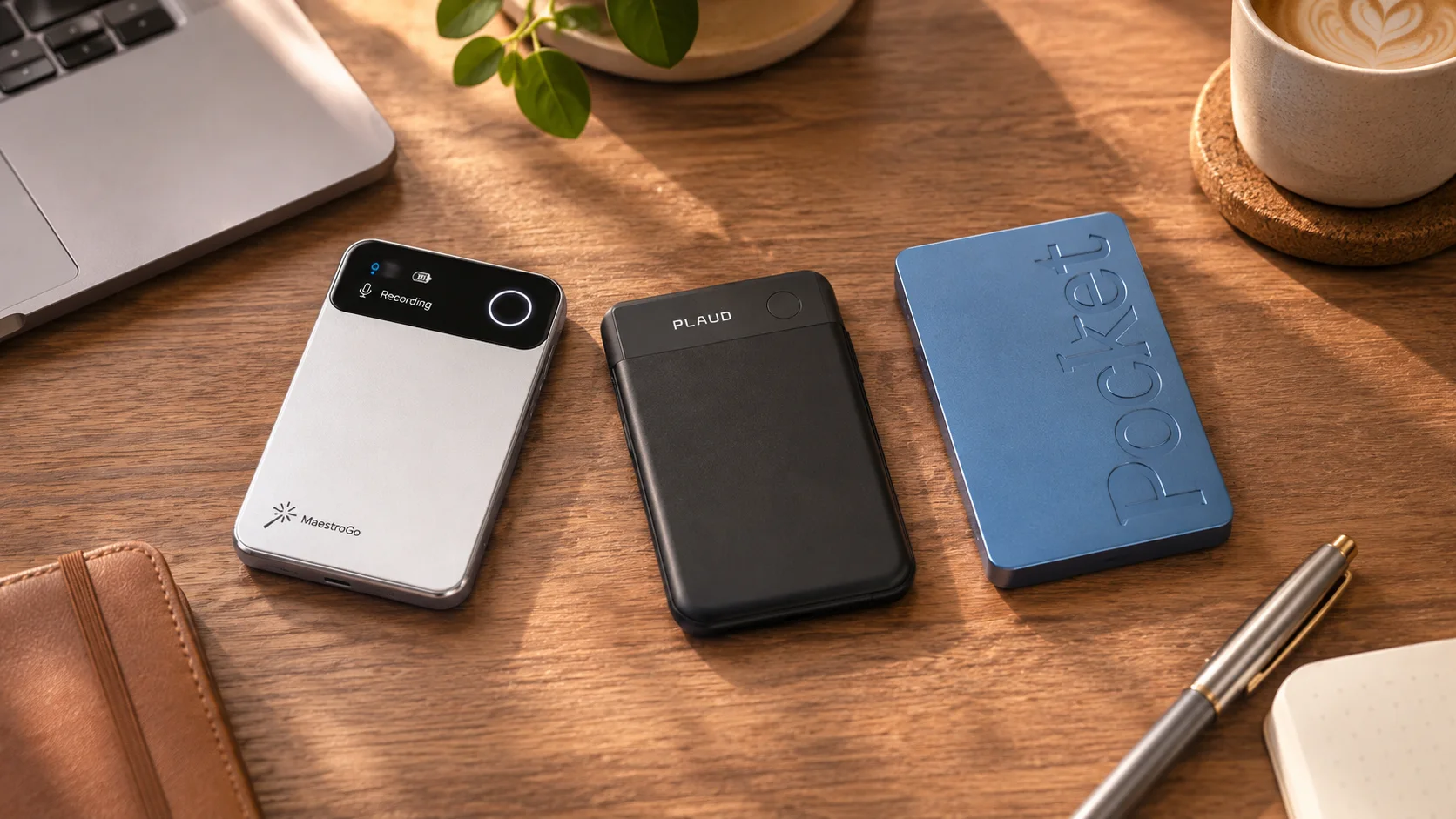
Plaud Note Pro is the better device and Pocket is the better deal. Across ten categories Plaud wins six, Pocket wins three and one is a tie, but Pocket's three include the one many buyers care about most, which is price.
| Category | Winner | Why |
|---|---|---|
| Weight, screen and microphones | Plaud Note Pro | 30 g against 52 g, a screen, and four microphones to Pocket's two. |
| Charging and attaching to a phone | USB-C and a built-in magnetic back. Plaud needs its own cable and a case. | |
| Capturing phone calls | Plaud Note Pro | Detects a call and switches mode on its own. On Pocket you switch by hand. |
| Speaker labels | Plaud Note Pro | More reliable at telling speakers apart. |
| Transcription on clear audio | Tie | No consistent difference between the two, even though Pocket has two microphones to Plaud's four. |
| Price and free transcription | $129 against $189 at list price, and no monthly limit on free transcription. Both run promotions, so check for a deal before you buy. | |
| Keeping your notes for free | Plaud Note Pro | Free history is kept without limit. Pocket removes free summaries after 30 days. |
| Languages | More than 120, against more than 112. Both cover so many that the gap only matters if you work in a less common regional language. | |
| Privacy commitments | Plaud Note Pro | A published SOC 2 Type II audit and an opt-in rule for AI training. |
| Online meetings | Plaud Note Pro | A desktop app records Teams, Zoom and Google Meet calls. |
Plaud vs Pocket vs MaestroGo: comparison table
Why MaestroGo appears from here on. The verdict above is Plaud against Pocket only, because that is the question you came with and we did not want to score our own product in it. From this table on we add MaestroGo, the recorder we make, so you can judge it on the same rows.
| Updated November 2026 | Plaud Note Pro$189 | Pocket$129 | MaestroGo$119 |
|---|---|---|---|
| Hardware | |||
| Weight | 30 gWithout its case | 52 g | 40 g |
| Battery, maker's figure | 30 h50 h in low-power mode | Up to 4 daysDepending on use | 40+ hContinuous recording |
| Microphones | 4 + vibration sensor | 2 + contact mic | 4 + contact mic |
| Screen | Yes | No | Yes |
| Attaches to your phone | Only inside a case | Built-in magnetic back | Built-in magnetic back |
| Charging | Proprietary magnetic cableFull in 2 h | USB-CFull in 1.5 h | USB-CFull in 1.5 h |
| Storage | 64 GB | 64 GB | 64 GB |
| Recording | |||
| In-person meetings | Yes | Yes | Yes |
| Both sides of phone calls | Yes | Yes | Yes |
| Meeting or call mode | Automatic | ManualChosen before recording | Automatic |
| Records without your phone | Yes | Yes | Yes |
| Teams, Zoom and Google Meet | Desktop appOn your computer | No | A bot joins for you |
| Plans | |||
| Free plan | 300 min a month | Unlimited transcriptionStandard accuracy | 300 min a monthPlus 5 online meetings |
| Free plan history | Unlimited | Summaries kept 30 days | Unlimited |
| Unlimited plan, per year | $239.99 | $239.88 | $204Includes unlimited online meetings |
| Transcription languages | 112+ | 120+ | 40+ |
| Privacy and terms | |||
| SOC 2 Type II | Yes | Not stated | Yes |
| Recordings used to train AI | Only if you opt in | Not stated | Never |
| Returns | 30 days | 30 days | 14 days |
Plaud and Pocket details come from plaud.ai and heypocket.com as of November 2026 and may change.
Which Plaud model compares to Pocket?
This comparison uses the Plaud Note Pro throughout because it is Plaud's flagship card recorder. The closer match to Pocket on specs is the cheaper Plaud Note, which like Pocket has two microphones, no screen and a manual switch between meeting and call mode.
Plaud sells four recorders, and only two of them do the same job as Pocket.
- Plaud Note Pro ($189): card-sized, records meetings and phone calls, and is the only Plaud recorder with a screen. It has the longest battery life of the four.
- Plaud Note ($159): the same card format for meetings and phone calls, with two microphones, no screen and manual mode switching. It is the closest Plaud to Pocket on specs and on price.
- Plaud NotePin S ($179) and NotePin ($159): wearable pins that record in-person conversations only. They do not record phone calls, so they are not a substitute for Pocket if calls matter to you.
If you are choosing between Pocket and a Plaud pin, the question is different: a pin is worn all day, while Pocket and the Plaud Note cards travel on your phone.
Design and hardware: Plaud Note Pro vs Pocket
All three are card-sized recorders with 64 GB of storage. The differences are in how they attach, how they charge and whether they have a screen.
Size and how it attaches to your phone
The Plaud Note Pro is the lightest of the three at 30 g, but that figure is without its case, and the case is the only way to attach it to a phone. Pocket (52 g) and MaestroGo (40 g) have a magnetic back built in, so they snap onto a MagSafe phone with nothing extra.
If you plan to carry the recorder on your phone every day, Pocket and MaestroGo are the simpler choice. If it will live in a shirt pocket or on a desk, Plaud's lower weight matters more.
Charging
Plaud charges through a proprietary magnetic cable and takes about two hours. Pocket and MaestroGo both charge over USB-C in about 1.5 hours.
This sounds like a small point until you travel. Lose or forget Plaud's cable and you cannot borrow one. With the other two, any phone charger works.
Screen
Plaud and MaestroGo have a small screen that shows whether the device is recording. Pocket has no screen and relies on an indicator light and the app.
Battery life
The three makers state battery life in different ways, so the numbers are not directly comparable.
- Plaud Note Pro: 30 hours of recording, or 50 hours in a low-power mode.
- MaestroGo: more than 40 hours of continuous recording.
- Pocket: "up to 4 days", depending on use.
Pocket's figure describes days of mixed use, not hours of recording. How each holds up in real use is covered further down.
Microphones
Plaud and MaestroGo each have four microphones for room audio, plus a separate sensor that picks up phone calls through the back of the phone. Pocket has two microphones and a contact microphone for calls.
Pocket vs Plaud: recording meetings and phone calls
All three record in-person meetings, capture both sides of a phone call, and keep recording when your phone is not nearby. They differ in how you switch between meetings and calls, and in what happens when the meeting is online.
Switching between meetings and calls
A room conversation and a phone call need different microphones. Plaud and MaestroGo detect a call on their own and switch for you. On Pocket you choose the mode before you start recording.
In practice this decides whether you capture the calls you did not plan for. If someone rings while the recorder is on your phone, Plaud and MaestroGo pick it up correctly. With Pocket you have to remember to switch first.
Online meetings
Most working weeks mix in-person conversations with Teams, Zoom or Google Meet calls. The three products handle the online half very differently.
Records the meeting on your computer. Those recordings count against the same monthly minutes as the device.
Pocket does not record online meetings. You would need a second tool.
The free plan includes five online meetings a month on top of the device minutes.
If all your important conversations happen face to face or on the phone, this does not matter and Pocket loses nothing. If you want one place for every meeting, it rules Pocket out.
Is Plaud or Pocket cheaper over two years?
The device price is the smaller part of the bill. What you pay over two years depends on whether the free plan is enough for you, and the three free plans are built very differently.
What the free plans include
| Plaud Note Pro | MaestroGo | ||
|---|---|---|---|
| Transcription | 300 min a month | UnlimitedStandard accuracy | 300 min a month |
| Online meetings | Use the same 300 min | Not available | 5 a month, on top |
| History | Kept without limit | Summaries removed after 30 days | Kept without limit |
Pocket advertises "no subscription required", and that is true. You can transcribe as much as you like without paying. The trade-off is twofold: summaries disappear from the app after 30 days, and Pocket keeps its highest-accuracy transcription and automatic speaker names for the paid plan.
Plaud and MaestroGo take the opposite approach. The free plan gives you full quality and keeps everything, but stops at 300 minutes a month, which is about five hours of recording.
Two-year cost
| Plaud Note Pro | MaestroGo | ||
|---|---|---|---|
| Device | $189 | $129 | $119 |
| Unlimited plan, per year | $239.99 | $239.88 | $204 |
| Light userFree plan, under 5 hours a month | $189 | $129 | $119 Lowest |
| Heavy userUnlimited plan for two years | $668.98 | $608.76 | $527 Lowest |
Why two years: one year understates what the subscription costs, and beyond two years device and plan prices are too likely to change.
A heavy user can also stay on Pocket's free plan and pay $129 in total. That is the cheapest way to record a lot, as long as standard accuracy is good enough and you never need a summary older than 30 days.
MaestroGo is the cheapest to buy. Pocket is $10 more and Plaud is $70 more.
Pocket comes to $609 and Plaud to $669. MaestroGo's plan also covers online meetings.
Its free plan is unbeatable if you never look back past 30 days.
Plan prices are the annual rates listed by Plaud, Pocket and Maestro Labs in November 2026. Pocket and Plaud both run promotions, so check the current price before you buy. MaestroGo's $119 is a launch price. At its $189 list price MaestroGo costs the same as the Plaud Note Pro to buy and $597 over two years on the unlimited plan.
Pocket AI vs Plaud: how they perform day to day
On clear audio, Plaud and Pocket transcribe about equally well. The differences show up in speaker labels, where Plaud is more reliable, and in noisy rooms, where both drop off. MaestroGo has the same four-microphone layout as Plaud, switches to call mode on its own, and writes the same recaps as TeamsMaestro online meetings.
| Plaud Note Pro | MaestroGo | ||
|---|---|---|---|
| Transcription, clear audio | Accurate on clear speech.Can trip on slang and industry jargon | On par with Plaud on clear speech.Names are sometimes misspelled | Transcribes clear speech accurately. |
| Noisy rooms | Copes with background music and large meetings.Drops off with heavy cross-talk | Drops off in crowded cafés and busy streets.Also with cross-talk | Four microphones, like Plaud. |
| Speaker labels | Reliable with around four people. | Slips when people talk over each other. | On par with Plaud. |
| Summaries | Good, with templates for decisions and action items. | Good, not perfect.Treat action items as a list to check | The same recap, decisions and action items as TeamsMaestro online meetings. |
| Phone calls | Works well on iPhone. | Clean on one-to-one calls.You select call mode first | Contact mic captures both sides.Detects calls automatically |
| Battery in real use | A few meetings use about a quarter of the charge. | No real-world figure published.Maker says up to 4 days | 40+ hours continuous.Maker's figure |
Languages and privacy: Plaud or Pocket?
Languages
Pocket lists more than 120 transcription languages, Plaud more than 112 and MaestroGo more than 40. MaestroGo covers the major business languages, but if you work in a less common one, check the list first. Plaud and Pocket are the safer choice there.
Privacy
A recorder hears everything in the room, so it is worth knowing what happens to the audio afterwards.
| Plaud Note Pro | MaestroGo | ||
|---|---|---|---|
| SOC 2 Type II audit | Yes | Not stated | Yes |
| Deletes the device copy after sync | Yes | Not stated | Yes |
| Recordings used to train AI | Only if you opt in | Not stated | Never |
"Not stated" means we could not find the information on heypocket.com in November 2026. It does not mean Pocket does the opposite. Pocket does offer a HIPAA mode on its Business plan, which is priced on request.
For confidential work such as legal, medical or HR conversations, Plaud and MaestroGo give you written commitments you can show a client or a compliance team. With Pocket's standard plans you would need to ask.
Where Plaud, Pocket and MaestroGo each win and lose
Plaud Note Pro
Wins
- The lightest of the three at 30 g.
- Switches between meeting and call mode automatically.
- More than 112 languages.
- 30-day returns.
Loses
- The most expensive device ($189) and the highest two-year cost ($669).
- Charges only through its own magnetic cable.
- Needs a case to attach to a phone.
Wins
- Unlimited free transcription. No other recorder here lets you record this much for nothing.
- The widest language support, at more than 120.
- Built-in magnetic back and USB-C charging.
- 30-day returns.
Loses
- Free summaries are removed after 30 days, and the best transcription sits behind the paid plan.
- Manual switching between meeting and call mode, no screen, and two microphones where the others have four.
- No online meetings, and no published SOC 2 audit or AI-training policy.
MaestroGo
Wins
- The lowest device price ($119) and the lowest two-year cost on an unlimited plan ($527).
- Switches between meeting and call mode automatically.
- Built-in magnetic back and USB-C charging, so no case or special cable.
- Covers Teams, Zoom and Google Meet with the same account.
Loses
- More than 40 languages, the fewest of the three.
- The free plan stops at 300 minutes a month.
- Newest of the three, so there are few independent reviews yet.
MaestroGo: the AI note taker built for Microsoft Teams
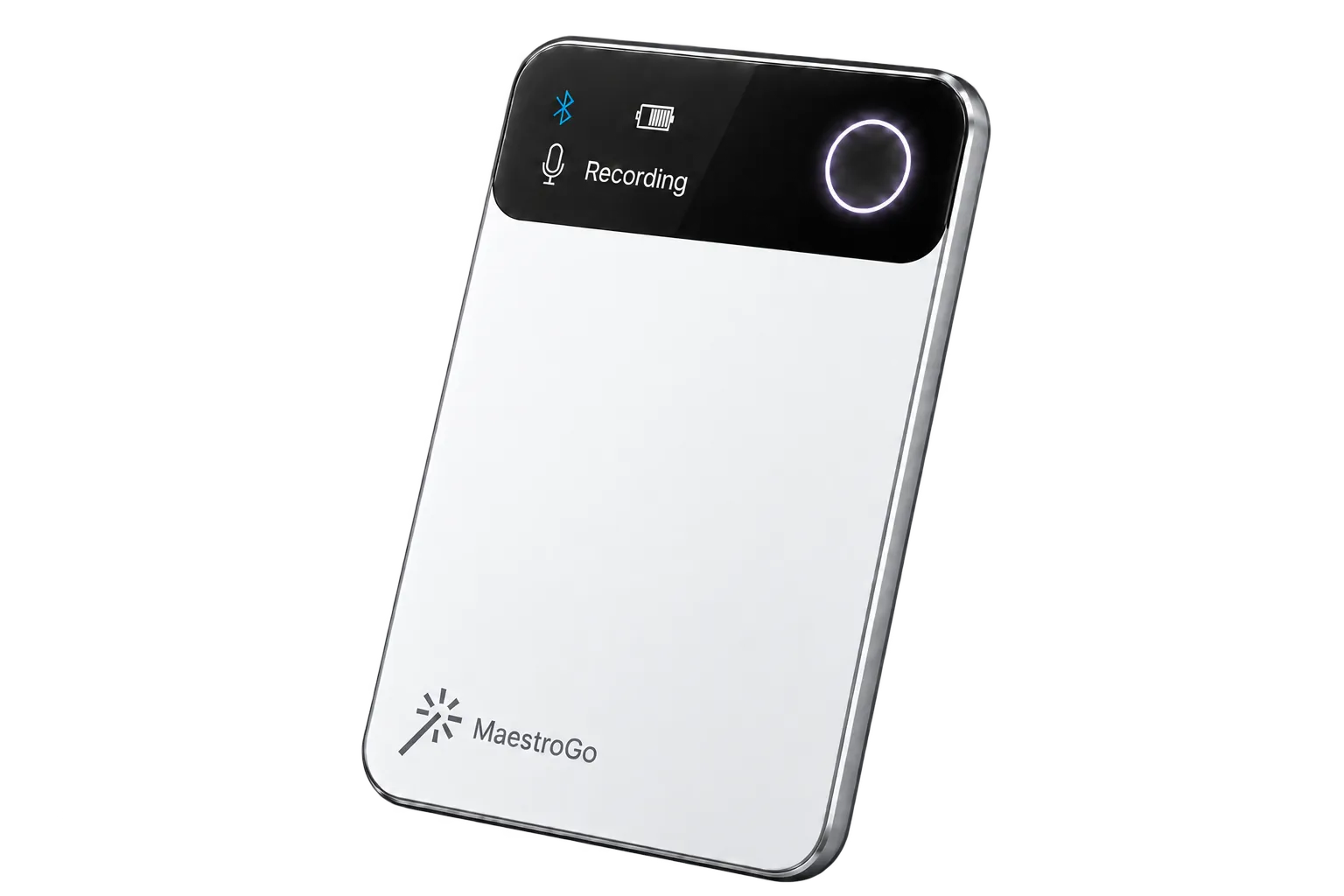
Plaud and Pocket are recorders first. Each keeps your notes in its own app, and you export or sync them out. MaestroGo is the hardware half of TeamsMaestro, a meeting assistant that already works inside Microsoft Teams.
- One history for every meeting. The hallway conversation you recorded sits next to the Teams call the bot joined, with the same summary format and the same search.
- No second subscription. If you or your company already use TeamsMaestro, the device works with the plan you have, including the free one.
- Company-ready. The TeamsMaestro Enterprise plan adds single sign-on, admin controls for company-wide settings, and license management with usage analytics. TeamsMaestro is SOC 2 Type II certified, and data is stored in the United States.

Plaud or Pocket: who should buy which
Plaud vs Pocket: frequently asked questions
Does Pocket need a subscription?
No. Pocket's free plan includes unlimited transcription at standard accuracy and unlimited summaries. Summaries are kept for 30 days on the free plan. The Pro plan, at $19.99 a month or $239.88 a year, keeps them permanently and adds higher-accuracy transcription and automatic speaker names. MaestroGo also works without a subscription: its free plan covers 300 minutes a month and keeps your full history.
Can I use Plaud without a subscription?
Yes. The Plaud Note Pro comes with a free plan that includes 300 minutes of transcription a month and keeps your history without limit. That is enough if you record less than about five hours a month. Online meetings recorded with Plaud's desktop app count against the same 300 minutes. Beyond that you need a paid plan. Plaud's unlimited plan is $239.99 a year.
Is Plaud worth it?
Plaud Note Pro is worth it if you want the lightest recorder with a screen, automatic call detection and a published SOC 2 Type II audit, and you either record under five hours a month or accept $239.99 a year for the unlimited plan. If price matters most, Pocket costs $60 less and transcribes without a monthly limit on its free plan.
Can Plaud and Pocket record phone calls?
Yes. Both capture both sides of a call through a sensor that rests against the back of your phone. Plaud detects the call automatically. On Pocket you select call mode before you start. Recording calls is subject to consent laws that vary by country and state, so tell the other person. MaestroGo records both sides too, and detects the call automatically like Plaud.
Which Plaud model should I compare with Pocket?
This page compares the Plaud Note Pro because it is Plaud's flagship. Like Pocket, it is a card-sized recorder that sits on the back of a phone and records both meetings and phone calls. The Plaud Note ($159) is the closer match on specs: like Pocket it has two microphones, no screen and manual mode switching. The Plaud NotePin and NotePin S are wearable pins that record in-person conversations only, so they do not replace Pocket for phone calls.
Are Plaud and Pocket the same device?
No. Plaud and Pocket are separate products from separate companies. The Plaud Note Pro is made by Plaud Inc. Pocket, also sold as Pocket AI or HeyPocket, is made by Open Vision Engineering Inc. They look alike because both are card-sized recorders that attach to the back of a phone, but they differ in weight, charging, call detection, free plan and privacy commitments.
Is Plaud a Chinese company?
Plaud Inc. is registered in Delaware and headquartered in San Francisco. It was founded in Shenzhen in 2021 and manufactures its devices there. Pocket is made by Open Vision Engineering Inc., a Y Combinator-backed startup.
Which is better for privacy, Plaud or Pocket?
Plaud publishes more. It has a SOC 2 Type II audit, deletes the copy on the device after syncing, and uses recordings to train AI only if you opt in. As of November 2026 we could not find the equivalent statements on Pocket's site.
Is there a good alternative to Plaud and Pocket?
MaestroGo, which we make, costs $119 at its launch price ($189 list) and aims for the best of both. It picks up phone calls on its own like Plaud, snaps onto your phone like Pocket and needs no custom charger. It also covers your Teams, Zoom and Google Meet calls. It supports fewer languages than Plaud or Pocket.
Ready to start?
MaestroGo works with the free TeamsMaestro plan, so there is nothing else to pay until you need more than 300 minutes a month.
$119- Free shipping in the US
- 1-year warranty
- 14-day returns